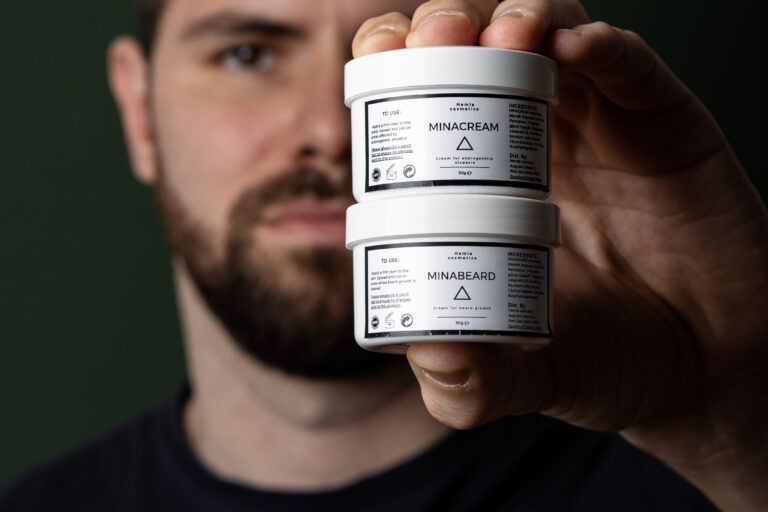

For over three decades, Minoxidil has been the gold standard of topical hair restoration. Yet nearly 60% of users see no significant regrowth. The combination of Tretinoin and Minoxidil for hair growth is changing that – by addressing the enzymatic bottleneck that causes most treatment failures
The issue stems from a specific enzymatic “on-switch” that is often missing or underactive in the patient’s scalp rather than a fault in the molecule itself. Recent advancements in pharmaceutical compounding have revealed a potent solution: the use of topical Tretinoin as a synergistic catalyst.
Why Minoxidil Alone Fails to Stimulate Hair Growth
To understand why Minoxidil fails for the majority of users, we must first look at its pharmacology. Minoxidil is a prodrug; in its bottled form, it is biologically inactive. To trigger hair growth, it must be converted into its active metabolite, Minoxidil Sulfate.
This conversion happens within the hair follicle, catalyzed by an enzyme called Sulfotransferase (specifically SULT1A1). The clinical problem lies in the fact that SULT1A1 expression varies wildly between individuals. Research has shown a direct, linear correlation between follicular sulfotransferase activity and the success of topical minoxidil. If a patient’s scalp has low enzymatic activity, they can apply 5%, 10%, or even 15% minoxidil indefinitely with zero results. The molecule remains dormant on the scalp, unable to engage the follicle.
Tretinoin: Beyond Simple Exfoliation
Traditionally known as a gold-standard acne treatment and anti-aging retinoid, Tretinoin (all-trans retinoic acid) has found a second life in hair restoration. While its role is often dismissed as merely peeling the skin to allow for better penetration, its true value lies in its ability to fundamentally alter the biochemical environment of the scalp.
Clinical studies, most notably by Sharma et al. (2019), have demonstrated that topical Tretinoin significantly increases the expression of the SULT1A1 enzyme in the human scalp. In their study, nearly 43% of subjects who were non-responders to minoxidil monotherapy were converted into “responders” after just five days of co-administration with Tretinoin. By upregulating the very enzyme that Minoxidil depends on, Tretinoin “primes the pump,” ensuring that once the Minoxidil reaches the follicle, the enzymatic machinery is ready for conversion.
How Tretinoin and Minoxidil for Hair Growth Work Together
The synergy between Tretinoin and Minoxidil is twofold:
- Potentiation (Enzymatic Upregulation): Tretinoin increases the concentration of Sulfotransferase, providing an internal fix for non-responders.
- Penetration (Stratum Corneum Modification): Tretinoin thinned the stratum corneum (the outermost layer of dead skin cells) and compacts the keratin layer. This reduces the physical barrier, allowing the Minoxidil molecule—often suspended in a vehicle—to reach the hair bulb more efficiently.
This dual action creates a “1+1=3” effect. In a compounded setting, adding even a small concentration of Tretinoin (typically 0.01% to 0.025%) can make a 5% Minoxidil solution more effective than a 10% solution used alone. This is why combining Tretinoin and Minoxidil for hair growth produces results that neither compound achieves alone.
The Formulation Challenge: Stability and Irritation
As a pharmacist, I must emphasize that you cannot simply mix a tube of Retin-A with a bottle of Rogaine at home. Tretinoin is a notoriously unstable molecule, highly sensitive to light (photo-degradation) and oxidation. Furthermore, the high alcohol and propylene glycol (PG) content found in mass-market minoxidil can lead to severe dermatitis when combined with a retinoid.
This is where Precision Compounding becomes essential. At Hemia Cosmetics, we utilize advanced, lipid-based vehicles that stabilize the Tretinoin and mitigate the irritation typically associated with the retinoid uglies. By removing harsh solvents like PG and replacing them with biocompatible lipids, we allow the scalp to tolerate the Tretinoin-induced enzyme upregulation without the flaking and redness that often leads to patient non-compliance.
The 2026 Outlook: Moving Beyond Monotherapy
The era of “one-size-fits-all” minoxidil is coming to a close. We are moving toward an era of Personalized Trichology, where we address the metabolic state of the patient rather than treating the treatment as a simple commodity. For the clinician, the lesson is clear: if a patient is not responding to Minoxidil after four to six months, increasing the concentration of Minoxidil is rarely the answer. The focus should instead shift to enzymatic upregulation. By incorporating Tretinoin into the topical regimen, we can activate the follicles of millions of men and women who were previously classified as non-responders.
Conclusion: A Scientific Rebuttal to Failure
Non-response to hair loss treatment represents a mismatch between the drug and the patient’s local biochemistry rather than a failure of the drug itself. The science behind Tretinoin and Minoxidil for hair growth is clear: non-response is an enzymatic problem, not a molecular one. As we continue to refine our understanding of follicular enzymes, the role of the compounding pharmacist becomes more critical than ever. Through the strategic use of Tretinoin, we are doing more than selling a product; we are re-engineering the scalp’s ability to heal itself.