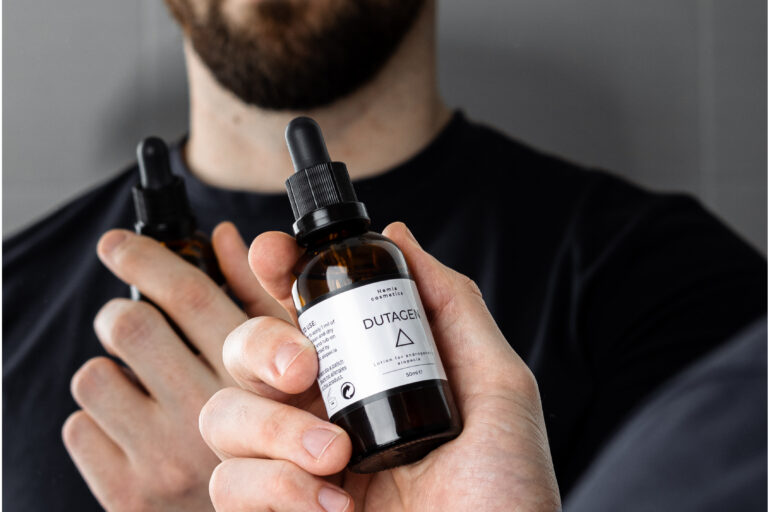

Topical dutasteride for hair loss represents the next clinical step when oral finasteride fails to deliver satisfactory results, or when systemic side-effect anxiety becomes a barrier to continued treatment. While oral dutasteride is the logical pharmacological escalation, switching to a systemic dual-inhibitor introduces a significantly stronger impact on the endocrine profile. A topical formulation offers the same dual-enzyme blockade with a fundamentally different risk equation — and evaluating it requires balancing molecular physics against enzymatic data.
Evaluating Topical Dutasteride requires balancing molecular physics against enzymatic data. It is not simply a stronger version of finasteride, it is a distinct pharmacological approach with clear clinical benefits and specific physical limitations.
1. How Topical Dutasteride Achieves Dual-Enzyme Inhibition
To understand the therapeutic distinction, we must look at the isoenzymes of 5-alpha reductase (5-AR). Finasteride is highly selective for the Type II isoenzyme, which resides predominantly within the hair follicle loop and the prostate. Dutasteride acts as a competitive inhibitor for both Type I and Type II pathways (Olsen et al., 2006).
- The Local Rationale: While Type II 5-AR remains the primary driver of androgenetic alopecia (AGA), Type I 5-AR is highly expressed in human sebaceous glands and contributes to local scalp dihydrotestosterone (DHT) production.
- The Clinical Catch: Orally administered dutasteride suppresses systemic serum DHT by upwards of 90%. While highly effective at halting miniaturization, throwing such a heavy systemic hammer at a localized scalp issue significantly scales the potential for adverse endocrine profiles.
A topical formulation seeks to achieve that dual-pathway enzyme blockade locally within the scalp tissue, isolating the therapeutic effect while sparing circulating systemic hormones.
2. The 500 Dalton Rule: Can Topical Dutasteride Penetrate Skin?
A frequent critique of topical dutasteride focuses on whether a molecule of its size can realistically traverse the skin barrier. According to the classic 500 Dalton Rule for percutaneous absorption, compounds must possess a molecular weight below 500 Da to easily pass through an intact stratum corneum (Bos & Meinardi, 2000).
- Finasteride: 372.5 Da (Safely below the threshold, meaning it readily diffuses across membranes but is prone to systemic leakage if the vehicle is not optimized).
- Dutasteride: 528.5 Da (Exceeds the 500 Da threshold).
Because the dutasteride molecule is physically heavier and larger, its transcellular diffusion through the lipid bilayers of the stratum corneum is naturally restricted.
However, this does not mean it is ineffective. Instead, topical dutasteride for hair loss relies heavily on the appendageal pathway—meaning it migrates directly into the lipid-rich environment of the hair follicle openings. This structural constraint works to our advantage; it allows the molecule to accumulate locally within the follicular infundibulum (forming a localized depot effect) while naturally resisting rapid transit into the deeper, highly vascularized capillary beds.
3. Clinical Trial Results for Topical Dutasteride
While compounding pharmacies frequently utilize concentrations of 0.1%, it is important to look at what controlled clinical trials validate.
A recent randomized, double-blind Phase II clinical trial evaluated the safety and efficacy of localized dutasteride solutions at lower concentrations (0.01%, 0.02%, and 0.05% w/v) against oral finasteride over 24 weeks (PMC12405733, 2025).
The data revealed that the 0.05% topical dutasteride for hair loss solution significantly improved target area hair count compared to oral finasteride, while inducing only modest changes to serum DHT levels compared to the moderate systemic drops caused by the oral control. Furthermore, open-label pilot studies utilizing specialized physical delivery methods (such as iontophoresis with a 6% gel) have successfully demonstrated significant improvements in both hair density and shaft diameter for treatment-resistant patients without generating systemic adverse events (Cedirian et al., 2025).
The Balanced Clinical Verdict
Topical dutasteride is a precise tool, but it is not a risk-free alternative. Its primary clinical advantage stems from its physical molecular weight, which inherently restricts rapid systemic absorption compared to smaller molecules.
However, dutasteride possesses an exceptionally prolonged terminal half-life of roughly 4 to 5 weeks. This means that if systemic absorption does occur due to an aggressive vehicle or a compromised scalp barrier, any resulting side effects will take significantly longer to resolve than they would with finasteride. For an advanced hair maintenance strategy, it represents a highly logical and effective upgrade, provided it is approached with strict attention to vehicle formulation and clinical tracking.
Academic Sources and References:
- Bos, J. D., & Meinardi, M. M. (2000). The 500 Dalton rule for the skin penetration of chemical compounds and drugs. Experimental Dermatology, 9(3), 165–169.
- Cedirian, S., et al. (2025). Efficacy of Skin Patting and Iontophoresis with Dutasteride Gel in Male and Menopausal Female Androgenetic Alopecia: A Pilot Study. Dermatology and Therapy (Heidelberg), Online Ahead of Print (PMID: 40900274).
- Olsen, E. A., et al. (2006). The importance of dual 5alpha-reductase inhibition in the treatment of male pattern hair loss: Results of a randomized placebo-controlled study of dutasteride versus finasteride. Journal of the American Academy of Dermatology, 55(6), 1014–1023.
- PMC12405733 (2025). A Randomized, Double-Blind, Placebo and Active Controlled Phase II Study to Evaluate the Safety and Efficacy of Novel Dutasteride Topical Solution (0.01%, 0.02%, and 0.05% w/v) in Male Subjects With Androgenetic Alopecia. (Published Trial Data, PubMed ID: 40909044).